NewsBy FilmFocus
Marix Launches "NEO" 35mm Film, Based on Remjet-Free Kodak Vision3
This is an AI translation of an article originally published in Japanese. If anything reads oddly, the Japanese original is the authoritative version.
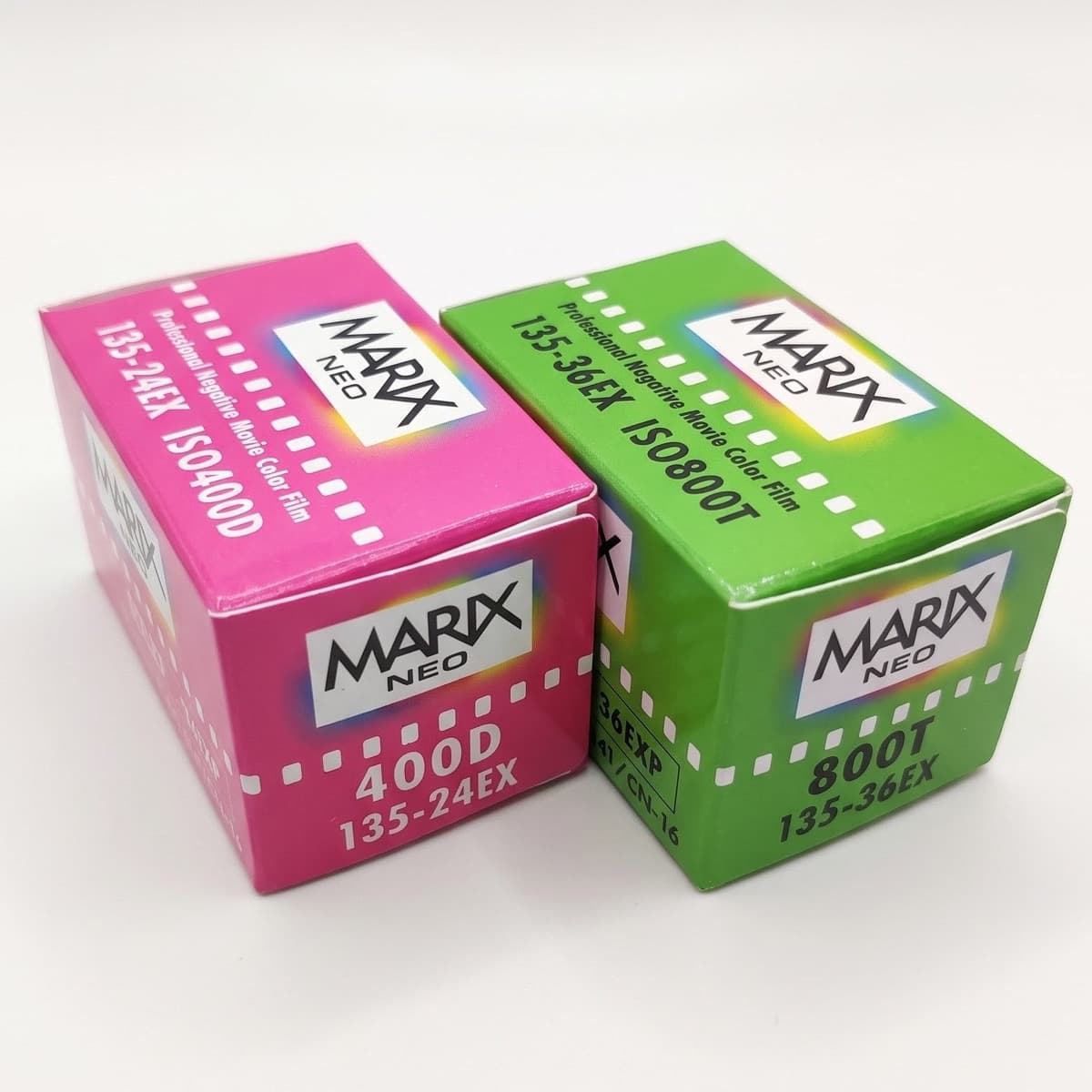
Film brand Marix (マリックス) has announced a new series called NEO. It takes the new remjet-free Vision3 (motion picture color negative film), which Kodak has been switching over to since 2025, and respools it into 35mm. The first release comprises two stocks, 400D (24 exposures) and 800T (36 exposures), and both are already on sale in the company's online shop.
 Source: marixfilm.com
"AHU" Instead of Remjet
Motion picture color negative film has traditionally had a black carbon layer called remjet coated on its back. It protects against halation, scratches and static, and in ECN-2 motion picture processing it is washed off as the very first step. If the film goes straight into a C-41 photo processor, the remjet comes off and contaminates the chemistry and the machine, so film intended for C-41 processing has usually had its remjet removed before shipping. Until now, Marix has also sold its films as C-41-compatible after putting them through this removal step.
In summer 2025, Kodak announced that it would drop remjet from four Vision3 products (500T / 200T / 250D / 50D) and gradually switch them over to a new construction. In place of remjet, there is now a layer beneath the emulsion called "AHU (Anti-Halation Undercoat)," which is removed during processing. AHU is a gelatin layer containing silver, and like the antihalation layer in still photo film, it disappears in the bleach and fix steps, so unlike remjet it doesn't need to be stripped off in a separate step. According to Kodak's documentation (PDF), characteristics such as speed and tonality are the same as the previous version. An antistatic layer that remains after processing has also been added to the back, which Kodak says makes the film less likely to attract dust during scanning.
NEO uses this AHU version of Vision3. Marix says that eliminating the removal step makes processing more consistent, and that the antistatic effect also reduces dust when scanning. Marix specifies C-41 (CN-16) processing, the same as regular color negative film, and the film also carries DX coding.
Lineup and Pricing
The first NEO releases are 400D and 800T. Each comes in two formats: a "boxed" version with an outer box and canister case, and an "Eco Pack" with the cassette sealed in a light-tight aluminum vacuum pack (shipped via Yu-Packet).
| Product | Exposures | NEO | Previous version |
|---|---|---|---|
| 400D (boxed) | 24 | ¥2,300 | ¥2,150 |
| 400D (Eco Pack) | 24 | ¥2,000 | ¥1,700 |
| 800T (boxed) | 36 | ¥3,300 | ¥2,650 |
| 800T (Eco Pack) | 36 | ¥2,900 | ¥2,450 |
Prices include tax and are as listed on the official store as of October 19. The previous 800T (36 exposures) is out of stock in both the boxed and Eco Pack versions. Compared with the previous versions, NEO costs ¥150 to ¥650 more, with the gap especially large for 800T.
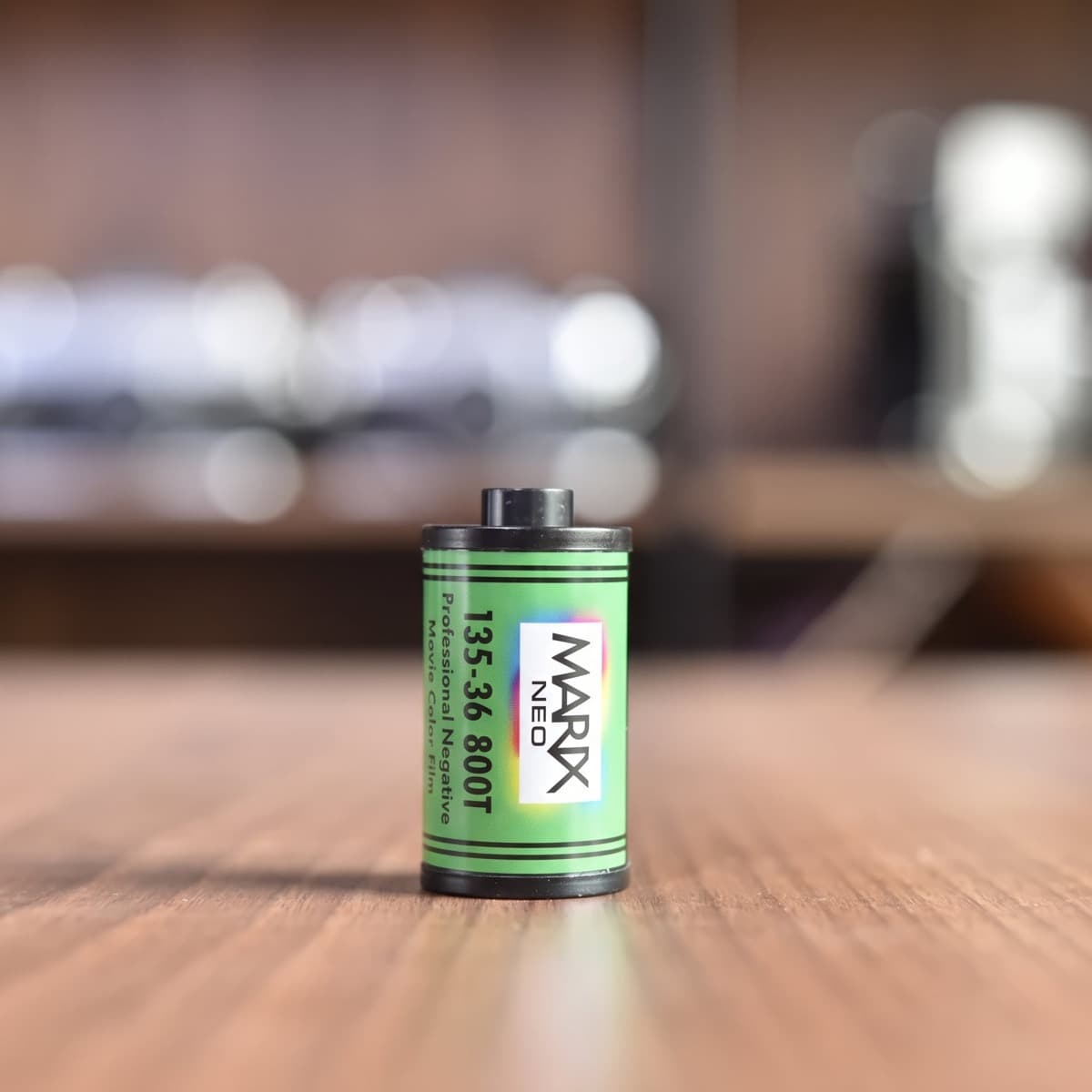 The Eco Pack arrives as just the cassette. Shown here: 800T (Source: marixfilm.com)
For 800T, Marix explains that Vision3 500T, rated at ISO 500, can be shot at ISO 800 when processed in C-41. This is the same rating as CineStill 800T. Marix doesn't state the base stock for 400D, but since Vision3 has only two daylight stocks, 250D and 50D, it appears to be 250D rated at ISO 400.
Meanwhile, Reflx Lab, discussed below, sells the same AHU version of 500T at ISO 640 for C-41, and 250D at ISO 320. Even with the same source stock, the speed it's sold at differs by about 1/3 stop depending on the brand.
Red Halos Like CineStill May Be Less Likely
Film with the remjet removed is shot without any antihalation layer. That's why CineStill 800T produces red halos around streetlights and neon signs.
The AHU layer is still present when you shoot and is only removed during processing. Kodak says that in comparison tests AHU suppressed halation even better than remjet, and there are already reviews abroad stating that "the AHU version of 500T doesn't render like CineStill 800T." NEO 800T may likewise render light sources differently from remjet-removed film. Marix says nothing about halation, so it's best to wait for sample images before drawing conclusions.
A Year and a Half Since Kodak's Distribution Restrictions
In January 2025, FilmFocus reported that Kodak had begun restricting sales of its motion picture film. The following February, Reflx Lab explained that it had "a few months' worth of 500T and 250D stock," raising concerns that respooled film might disappear from store shelves.
 Kodak Moves to Restrict Distribution of Motion Picture Film, Possibly Affecting Respooled ResalesWith demand for photographic film on the rise, news that Kodak has begun restric…FilmFocus
 Only a Few Months of 500T / 250D Stock Left: Reflx Lab Explains Where Its Respooled Film Sales Stand"Kodak's decision threatens the innovation and creativity that independent photo…FilmFocus
Reflx Lab now sells 320D, 640T and 50D, made from the AHU versions of 5207 (250D), 5219 (500T) and 5203 (50D). Marix's NEO is part of the same trend. Neither company has disclosed how it sources its film, and it's unclear how Kodak's sales policy is currently being applied. Still, motion picture film respooled for still photography hasn't dried up, at least for now, and what's inside is shifting to the AHU version.
What It Means for Labs
The switch to AHU looks like a welcome change for labs as well. As we noted in our February 2025 article, if ECN-2 film with its remjet still intact went into a C-41 processor, the lab sometimes had to replace all of its chemistry. With film based on the AHU version, that worry goes away.
However, Kodak says it will switch over gradually as inventory turns over, and Vision3 with remjet is still in circulation. Some respooled films, such as Reflx Lab's 250D (ECN-2), are also still sold with the remjet left on. As before, take care not to process film labeled "ECN-2" in C-41.
Marix says it will gradually move its other films to the NEO series as well. No date has yet been announced for when the 100D and 320T currently on sale will switch over.