NewsBy FilmFocus
From the UK: Home Film Scanner "Knokke" Opens for Pre-Orders at £799
This is an AI translation of an article originally published in Japanese. If anything reads oddly, the Japanese original is the authoritative version.
UK-based Soke Engineering is preparing to launch Knokke, a 35mm film scanner for home use. The company says it can scan a 36-exposure roll in under three minutes, at roughly 22 megapixels per frame. The planned price is £799 in the UK (about ¥167,000 at the October 6 exchange rate), and orders from outside the UK are £665.83 (about ¥139,000) without UK VAT. The official site says orders will be taken with a £200 deposit, with shipments rolling out from early December (as of October 5, the order button reads "Coming soon").
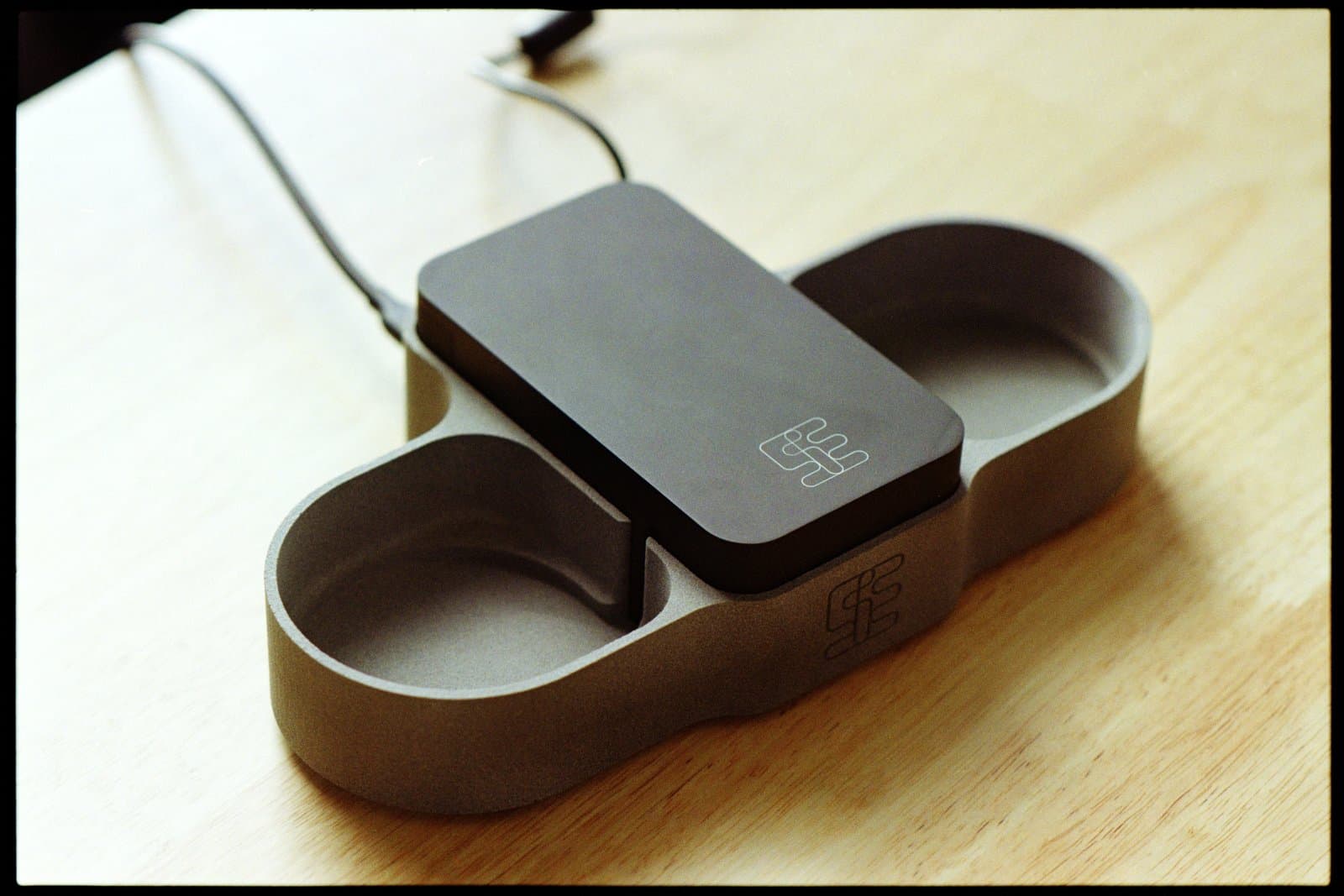 Source: soke.engineering (Photo: Will Dolan)
- Knokke Film Scanner – Soke Engineering
- Download Korova – Soke Engineering
- This stylish premium-priced film scanner wants to save you from lab scans for good – Digital Camera World
- A modern 35mm film scanner for home – Hacker News
Supports a range of aspect ratios, from half-frame and 35mm to XPan
According to the company's Instagram posts, no holder is needed: the scanner advances the film itself and automatically crops each frame using the gaps between frames as a guide. Frame spacing is re-measured for every roll, so any aspect ratio works as long as the frame height is 24mm. The company says half-frame, standard 35mm, panoramic and the wide XPan format are all supported as is.
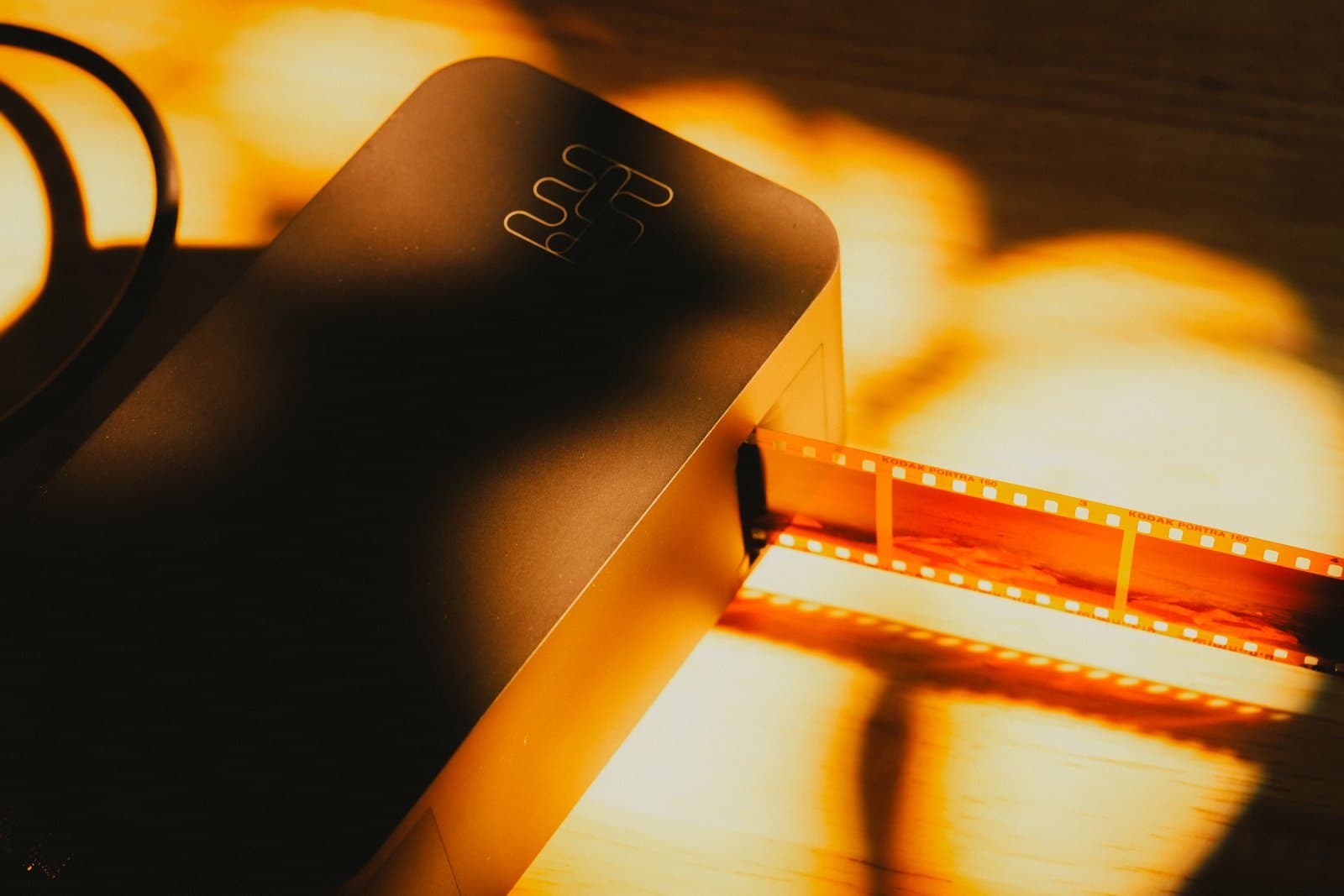 Knokke with film inserted. Source: soke.engineering (Photo: Will Dolan)
During scanning, the captured images are displayed in real time in the bundled software, and frame detection, orientation correction and dust/scratch detection all run in parallel with the scan. Once it's done, negative inversion, color correction and export are all handled within the same software.
The current specifications don't say so explicitly, but the specs at the 2025 announcement stated that it "can transport strips as short as 3 frames," so it appears designed to handle cut negatives too.
Key specifications
The specifications listed on the official site are as follows.
| Item | Specification |
|---|---|
| Supported film | 135 (35mm) strips. Color and black-and-white, negative and positive. Mounted slides not supported |
| Resolution | Equivalent to 4000dpi (approx. 22MP per frame), up to 5,760 × 3,840px |
| Sensor | Stacked backside-illuminated (BSI) CMOS |
| Bit depth | 48-bit color (16 bits per channel) |
| Capture method | Each frame shot three times, lit sequentially by red, green and blue (trichrome) |
| Light source | 4-channel LED: red 680nm, green 550nm, blue 450nm, infrared 940nm |
| Scan time | Under 3 minutes for one 36-exposure roll at maximum resolution, including infrared dust removal |
| Lens | 4 elements |
| Export | TIFF / JPEG / PNG (equivalent to 4000, 2000 and 1000dpi) |
| Connection | USB 3.0 (5Gbps). No driver installation required |
| Body | Machined aluminum |
| Included | USB cable, power supply, carrying case, manual |
| Warranty | 1 year |
"Trichrome" capture of three separate colors, plus infrared dust removal
Typical digital camera sensors use a "Bayer array," in which each pixel has a filter for just one of red, green or blue, and the missing colors are interpolated from surrounding pixels. Knokke does away with this, lighting each frame sequentially with narrow-band red, green and blue LEDs and shooting it three times. Because all three colors are actually measured at every pixel, no interpolation takes place. According to the company, this allows the three dye layers of color negative film to be read with clean separation, and the orange base to be removed precisely rather than estimated. The LED wavelengths were chosen to match the film's dye layers. The idea of avoiding Bayer interpolation is the same one behind lab scanners such as the Frontier and Noritsu, and Knokke can be seen as an attempt to deliver it at a home-friendly size and price.
Another key feature is infrared dust and scratch removal. Color film dyes are almost transparent to infrared light, but dust, hair and scratches are not. This feature exploits that optical property: a separate exposure is taken with 940nm infrared, and anything that shows up is treated as dust and corrected.
Infrared dust removal itself has long been available not only on lab machines but also on home scanners from Epson, Plustek and others, under names like "Digital ICE" and "iSRD." On many models, however, adding the infrared pass significantly lengthens scan times. Knokke claims under three minutes per roll including dust removal, so it can be used without a time penalty.
Bundled software "Korova" recreates the feel of a minilab
Knokke comes with dedicated scanning software called "Korova," which is distributed free of charge. It's a native app for macOS, Windows and Linux, written from scratch in the Rust programming language. It requires no account registration or subscription, and everything from scanning to export works without an internet connection. The latest version is 1.11.0, released on September 28.
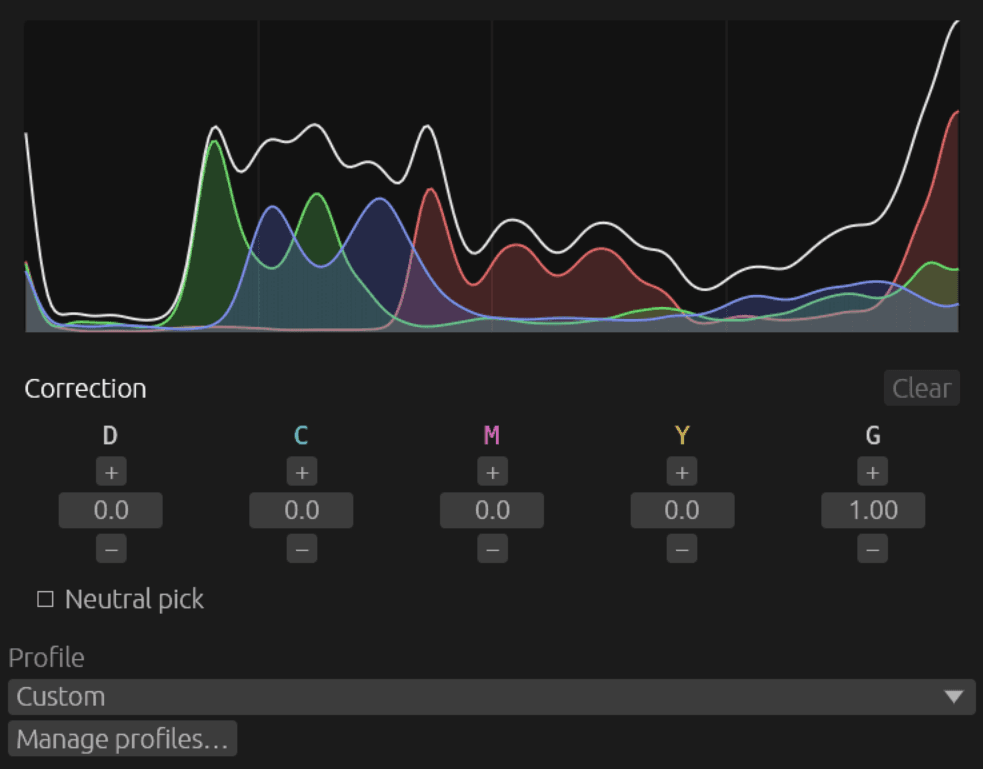 Korova's correction panel. In addition to D / C / M / Y, the paper grade (G) can be adjusted. Source: soke.engineering
Negative inversion uses a curve modeled on the characteristic curve of color paper (RA-4). Since color negatives were originally designed to be printed on paper, rather than simply inverting the colors and stretching them, the image is passed through the shoulder and toe of a paper curve, which the company says keeps bright highlights from blowing out to pure white. The film base density used as the reference isn't taken from a saved profile but measured each time from the unexposed areas between frames on that roll. Reversal film skips this curve and is processed linearly.
The color correction interface follows the D (density), C, M and Y key controls of Fujifilm's Frontier, with the addition of darkroom paper grade. Because the amount of correction per step stays the same from roll to roll, corrections can be saved as a "recipe" and carried over to the next roll. There's also a feature that calculates the correction needed to neutralize a gray area when you click on it. It's interesting to see it trying to recreate, at home and with the same feel, the adjustments that lab operators used to make.
Korova can be downloaded even without a Knokke. The official site's sample scans page offers RAW data captured with Knokke (about 12GB), which you can load into your own copy of Korova to try out inversion, color correction and dust removal (for personal, non-commercial evaluation only). If you're considering buying one, it's worth checking the image quality and the software's usability first.
What has changed in the year since the announcement
Knokke was first announced in November 2025. The plan at the time was to run a Kickstarter crowdfunding campaign in Q1 2026, with a launch price of €999 and a final retail price of €1,599. The company also said it was working with several labs in Berlin to compare and validate it against Fujifilm Frontier and Noritsu scanners.
Comparing the specs then and now, a great deal has changed.
| Item | At announcement (November 2025) | Now (October 2026) |
|---|---|---|
| Price | €999 (final retail price €1,599) | £799 (incl. UK VAT) |
| Sales method | Kickstarter | £200 deposit via official site |
| Light source | RGB LED backlight | Trichrome with sequential RGB lighting + infrared |
| Infrared dust removal | None | Yes (black-and-white detected by the software's Linter) |
| Scan time for one 36-exposure roll | Under 5 minutes (4064dpi) | Under 3 minutes (including dust removal) |
On the overseas forum Hacker News, where the announcement drew attention, commenters pointed not only to the high price but also to the lack of infrared dust removal, and argued that next-generation scanning would capture RGB separately with narrow-band LEDs. The current Knokke incorporates exactly those two points, while also cutting scan time and lowering the price.
There is, however, one more change. The official FAQ in 2025 stated that Korova would be made "fully open source," but the terms of use on the current download page state that Korova is "licensed, not sold" and prohibit modification and reverse engineering. As of this writing, Korova's source code has not been published on the company's GitHub account either. There has been no official explanation of whether the open-source plan has changed or has simply been pushed back.
New scanners for both home and lab
There are broadly three ways to digitize film: flatbed scanners, dedicated lab scanners and home film scanners (see FilmFocus's "Three Ways to Digitize Negative Film" for details). Of these, dedicated lab machines like the Fujifilm Frontier and Noritsu went out of production many years ago, and labs around the world are struggling to source parts. Into this landscape came the Aura 35, a lab scanner from France's Aura Lab. Following the higher-end Aura 35 Pro in 2025, orders opened in September for the "Aura 35 Minilab" aimed at local minilabs.
Knokke is likewise a "new scanner that doesn't depend on old machines," but one designed with ordinary home use in mind. Digital Camera World positions Knokke between "camera scanning," where film is photographed with a digital camera, and dedicated film scanners such as those from Plustek — in other words, a product for getting fast, automated, professional-quality scans at home. Looking at Korova, with its recreation of the Frontier's controls, the "lab scans at home" direction becomes even clearer.
Buying from Japan
Knokke is said to ship worldwide, but since it's an overseas purchase, it's worth checking in advance where repairs would be sent in case of a fault, as well as shipping costs and customs fees.
Soke Engineering is a UK company that describes itself as "a small studio building tools for the film photography community." The arrival of new film scanners one after another, for both home and lab use, is an encouraging development for the future of film photography. We plan to cover it again once hands-on reviews of the actual unit appear.