ColumnsBy FilmFocus
Reading a 1999 Paper on the Rivalry Between Kodak and Fujifilm
This is an AI translation of an article originally published in Japanese. If anything reads oddly, the Japanese original is the authoritative version.
Fujifilm and Kodak were the "big two" of film photography for decades. In the 1990s, the two companies were also at the center of a trade dispute between Japan and the United States. In this article, we look at a 1999 paper that analyzed their rivalry from an economic perspective: "Fujifilm-Kodak Duopolistic Competition in Japan and the United States".
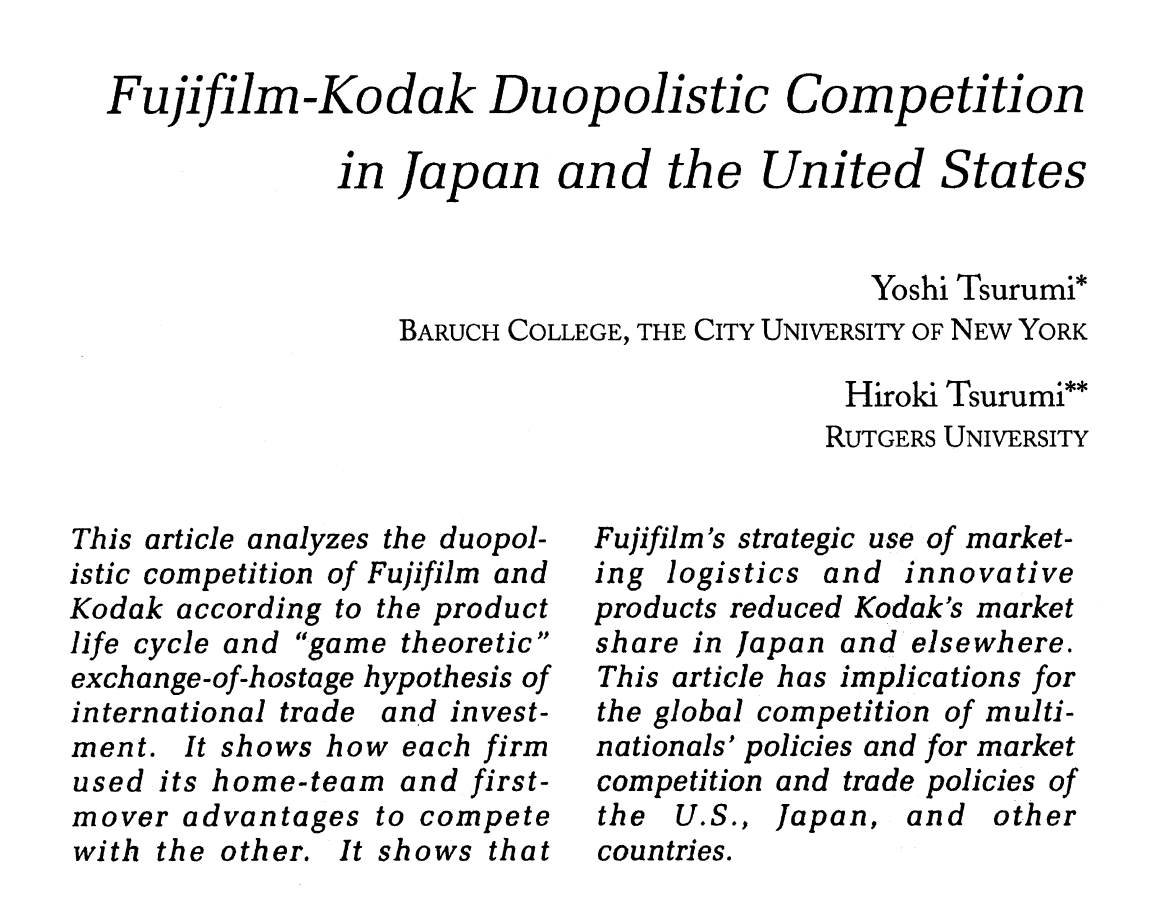
The authors are Yoshi Tsurumi of Baruch College and Hiroki Tsurumi of Rutgers University (both affiliations as of the time of writing). Using statistical tests on time-series market share data, the paper tackles one question: why did Kodak struggle in the Japanese market through the 1980s and 1990s?
It started with the US-Japan film dispute
In 1995, Kodak filed a petition under US trade law, claiming that Fujifilm and Japan's Ministry of International Trade and Industry (通商産業省; MITI, as it was then called) had colluded to shut Kodak products out of Japan's distribution network. Kodak's argument was that it held about 70% of the US market but only 10% in Japan, and that this gap was the result of unfair barriers to entry. The dispute went to the WTO, but in December 1997 the panel unanimously ruled in Japan's favor. The paper was written shortly afterward, and it uses both history and data to argue that Kodak lost not because of a conspiracy, but because it lacked a strategy.
Before the war, Japan was "Kodak's market"
The paper begins with a look back at the history of both companies. For roughly 70 years up to the early 1930s, Japan's photography market was dominated by Kodak exports. The turning point came in the early 1930s, when a Japanese chemical company, Dai Nippon Celluloid (大日本セルロイド), proposed a joint manufacturing venture in Japan to Kodak founder George Eastman and was turned down. In 1934, that company established Fuji Photo Film (富士写真フイルム). Two years later, Konishiroku (小西六), the predecessor of Konica, followed, and when war broke out between Japan and the US, Kodak's exports to Japan were cut off for a time.
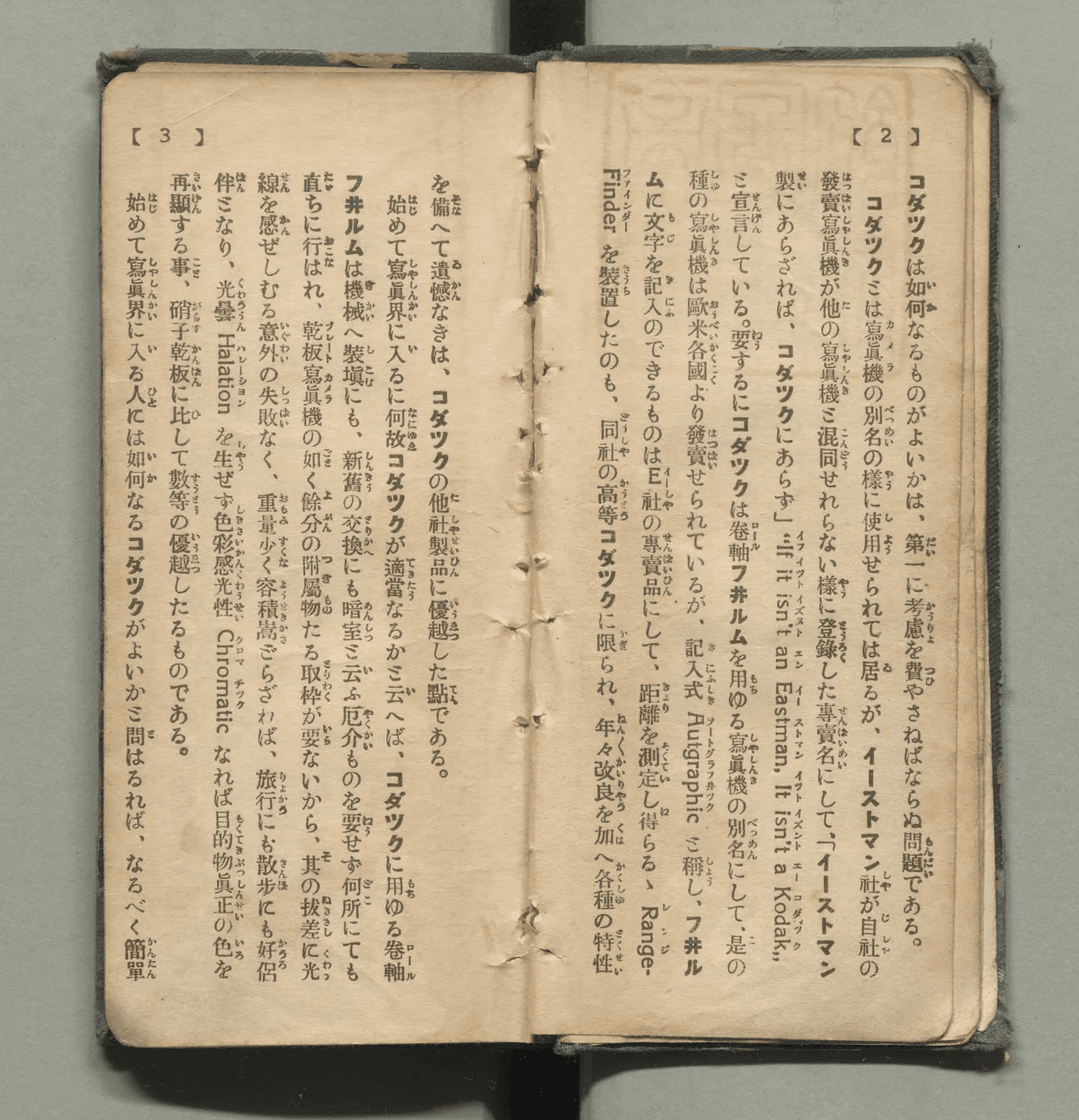 An excerpt from the 1919 book Vest Pocket Kodak Sakugahō: Firumu Shashinjutsu (Picture-Making with the Vest Pocket Kodak: The Art of Film Photography), one of the earliest documents confirming that Kodak products had been introduced to Japan. Source: National Diet Library
After the war, Kodak resumed exports to Japan in the 1950s. Japan lifted its import quotas in 1968, and the import tariff on film, initially 40%, had fallen to 5% by 1976. The Kodak brand kept its postwar image as a prestigious imported product, and the paper's view is that anything that could be called a barrier to entry steadily disappeared.
Kodak relied on an agent while Fujifilm moved first with minilabs
So why did Kodak struggle after that? The first factor the paper points to is distribution strategy. In 1971, Kodak gave Nagase & Co. (長瀬産業) exclusive rights to sell its products in Japan, and it didn't set up its own sales subsidiary until 1986 — a full 11 years after restrictions on foreign investment had been completely lifted. Nagase grew Kodak's share from 6.1% in 1971 to 17.7% in 1981 through aggressive price cutting, but the paper notes that in the Japanese market, discounting actually damaged Kodak's image as a premium product.
Fujifilm, meanwhile, began rolling out minilabs (small-scale photofinishing stations) in 1976. Its installations grew from just 10 locations in 1976 to 13,400 in 1994. Konica followed in 1983, and Kodak didn't have minilabs at all until the late 1980s. According to the paper's statistical analysis (detection of structural change points using Bayesian estimation, plus Granger causality tests), Kodak's share in Japan turned downward from around mid-1981, and the data support the hypothesis that the cause was the expansion of Fujifilm's minilab network. The analysis concludes that the battle to win over neighborhood photofinishing shops is what decided the outcome.
Expanding into the US as an "exchange of hostages"
The other highlight of the paper is its second half, which explains Fujifilm's entry into the US as an "exchange-of-hostage" strategy. This is a theory of behavior among oligopolistic firms that is often studied in economics: by establishing a presence in a rival's home market, a company secures a way to retaliate if its own home market comes under attack.
In 1958, Fujifilm opened a one-person representative office in Los Angeles and began researching the US market, including Kodak. In 1965, it set up a sales subsidiary, Fuji USA, in New York. When Kodak's share in Japan reached 10% in 1973, Fuji USA took over its US sales directly and began going after supermarkets, a channel Kodak had neglected. In 1981, it became the official film of the NBA, and at the 1984 Los Angeles Olympics it won the official sponsorship after Kodak declined to bid. By the paper's estimates, 1984 is exactly the year Fuji USA's share reached 10% and its growth entered a new phase. Two years later, Kodak acquired Nagase and established direct sales operations in Japan. Laid out on a timeline, the two companies' moves appear to have been linked as "retaliation" against each other.
| Year | Key events |
|---|---|
| 1934 | Dai Nippon Celluloid establishes Fuji Photo Film (Konishiroku enters two years later) |
| 1941 | Kodak's exports to Japan are cut off by the outbreak of war between Japan and the US (resumed in the 1950s) |
| 1958 | Fujifilm opens a representative office in Los Angeles and begins researching the US market |
| 1965 | Sales subsidiary Fuji USA is established in New York |
| 1971 | Kodak grants Nagase & Co. exclusive sales rights in Japan (Japan share: 6.1%) |
| 1973 | Kodak's share in Japan reaches 10%. Fuji USA brings US sales in-house and starts targeting supermarkets |
| 1976 | Fujifilm begins rolling out minilabs. Launches the high-speed film Fujicolor II-400 in Japan and the US |
| 1981 | Kodak's share in Japan peaks at 17.7% and begins to decline. Fuji USA becomes the official film of the NBA |
| 1984 | Fujifilm wins official sponsorship of the Los Angeles Olympics (Kodak declines to bid). Fuji USA's share reaches 10%, and Kodak ends its price-cutting offensive in Japan |
| 1986 | Kodak acquires Nagase & Co. and establishes direct sales in Japan |
| 1987 | Fujifilm launches a 35mm single-use camera (two years ahead of Kodak in Japan) |
| 1994 | Fujifilm's minilabs reach 13,400 locations. Fuji USA's share reaches 14% |
| 1995 | Kodak files a petition under Section 301 of US trade law (Kodak's share in Japan has fallen to 8.0%) |
| 1997 | The WTO panel unanimously rules in Japan's favor |
Beyond its era
Interestingly, the 1999 paper concludes by saying that "digital imaging technology is fundamentally changing the market structure of photography for the first time in 150 years, and the business foundations of both companies can no longer remain stable." The market did change dramatically, just as predicted, but the paper's framework — that market share is driven not by the quality of the film itself but by price, distribution and brand image — is still useful for making sense of today's Japanese market, where film has regained its popularity.
In FilmFocus's Film Photography Survey 2025, Kodak (71%) overtook Fujifilm (68%) in the share of respondents who had used each brand over the past year, taking the top spot. The likely reason is Fujifilm's steep price increase in June 2025. Thirty years after the Super 301 petition, the "reversal in Japan" that Kodak couldn't achieve even through trade policy has become reality (at least in terms of how many users shoot each brand), triggered by Fujifilm's own pricing strategy. It's a curious turn of events.
The nature of the market has changed, too. The Japan of the 1990s described in the paper was a market for "premium goods," where cutting prices actually hurt a brand's image. In our survey, however, "cost" (62%) was the top reason for shooting film less often for the second year in a row. Today, price is what moves users. On the other hand, when choosing a lab, more respondents prioritized "quality" (41%) than "price" (24%). The lesson of the minilab battles — that whoever controls the developing infrastructure wins — seems to live on in a different form.
It's an academic paper, but it's also an enjoyable read for anyone curious about the history of film photography, so if you're interested, we recommend checking out the original. You can read it with a free JSTOR account.