NewsBy FilmFocus
Fujifilm Launches a Film Camera Called the "Jelly Camera" in China, Priced at About ¥4,500
This is an AI translation of an article originally published in Japanese. If anything reads oddly, the Japanese original is the authoritative version.
Fujifilm's "Jelly Camera" is a film camera with a transparent (skeleton) body that went on sale in the Chinese market in November 2024. Its official name in China is "富士 C400 果冻胶卷相机". It comes preloaded with 36 exposures of ISO 400 color negative film, and its launch price was 209 yuan (about ¥4,500 at the exchange rate at the time, or roughly ¥4,950 at the rate as of August 28, 2026). As of August 28, 2026, the camera does not appear in the product lineup published by Fujifilm Japan, and we could find no official sales in Japan.
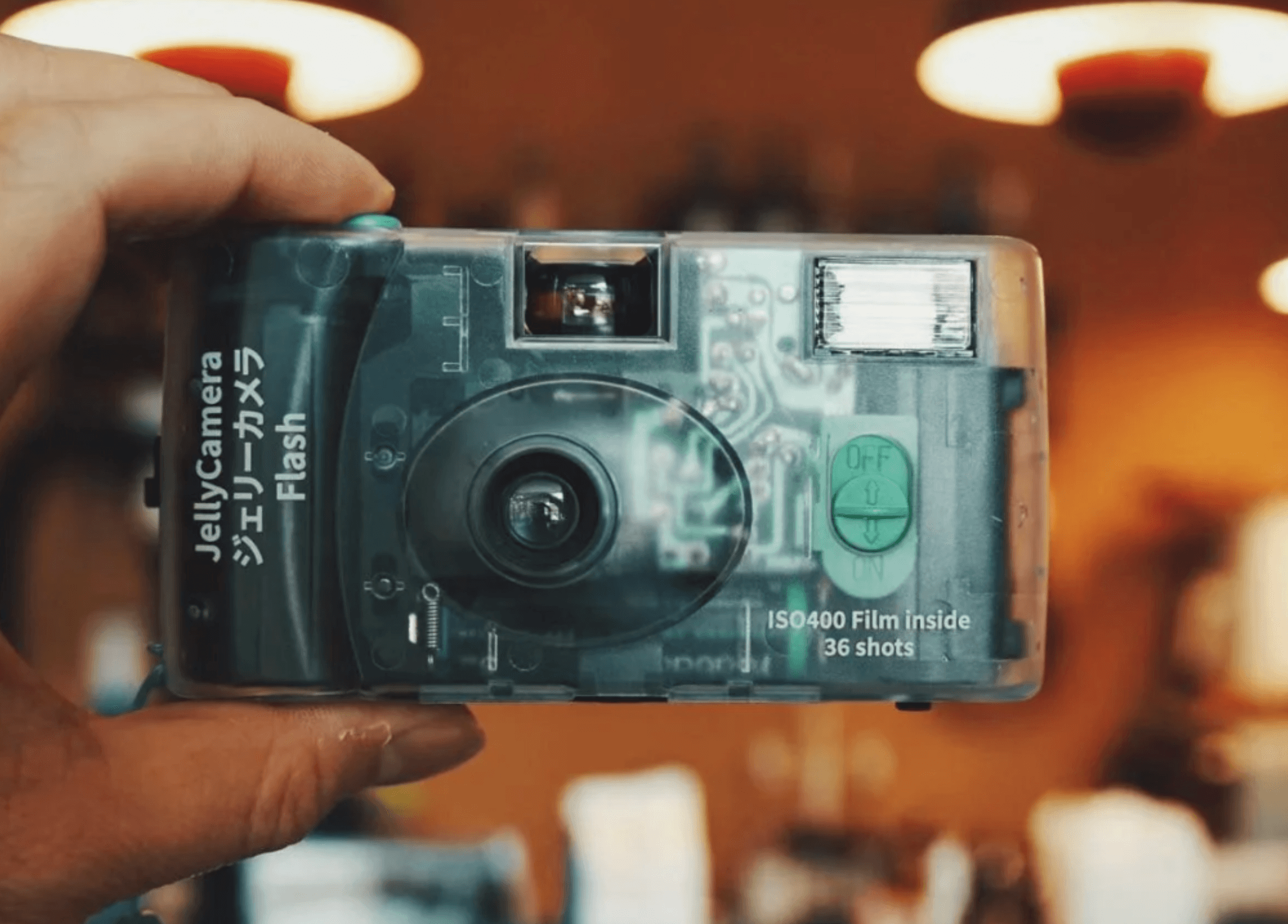 Image source: Reddit
What kind of camera is it?
It looks a lot like a Utsurundesu (QuickSnap)-style single-use camera, but the big difference is that once you've finished a roll, you can swap in new film and keep using it. The skeleton body has a built-in flash, and it handles almost exactly like a disposable camera. The idea is that it can be used in two ways: people new to film can treat it as a disposable, while more experienced shooters can keep the body and just reload it with film.
The specs announced at launch are as follows:
- Dimensions: 115 x 60 x 33mm
- Weight: 118g
- Film: preloaded ISO 400 color negative film (36 exposures)
- Lens: fixed 32mm f/11
- Shutter speed: 1/125 sec
- Flash: built-in (effective range 1–3m)
The preloaded film is C400, and any 135 film can be loaded
As the product name suggests, the preloaded film is Fujifilm's C400 film. C400 is a color negative film that the company began producing in China in June 2024.
On April 8, 2026, the official Weibo account of Fujifilm China's brand venue, "富士影像文化館" (Fuji Imaging Culture Hall), published instructions for changing the film. The post names C400 as the replacement film, but also states clearly that any 135 (35mm) film can be loaded. In other words, it's a camera you can fill with whatever film you like.
The published steps are as follows:
- When the winding wheel stops turning and the counter on top reads "36E", the roll is finished
- Cut the seal on the bottom of the body with a small knife, open the back while pressing the button on the side, and remove the exposed film
- Return the wheel on top to the "36E" position and insert a new roll of film
- Pull out the film leader and hook a sprocket hole onto the small tab at the upper left inside the camera
- Turn the winding wheel on the bottom of the body half a turn and check that the film advances properly. If all is well, close the back quickly to prevent fogging
- Once the back is closed, turn the wheel on the bottom of the body counterclockwise until it stops (about 30 turns)
Two cautions are given for loading: insert the film with the protruding end facing up, and never touch the catch above the slot in the center of the camera's interior.
Warranty
At launch, Chinese media reported that opening the back would void the warranty. Since Fujifilm China later published the film-changing instructions above in April 2026, its stance locally appears to have shifted from the original guidance.
Either way, the camera is not officially sold in Japan, so you shouldn't expect warranty or repair service from Fujifilm Japan. If you buy one, check the seller's own warranty and return terms.
Getting one from Japan
We could find no official sales in Japan. The camera sometimes turns up on Chinese e-commerce sites, cross-border e-commerce platforms and Japanese flea-market apps, but availability, prices and whether sellers ship to Japan all vary. When buying, check the following:
- Whether the preloaded film is unused
- The seller's ratings and their return and cancellation terms
- Whether they ship to Japan, and the total cost including shipping and customs duties
Compared with Utsurundesu and the Kodak EKTAR H35
| Jelly Camera | Utsurundesu Simple Ace | Kodak EKTAR H35 | |
|---|---|---|---|
| Type | Reloadable | Single-use | Reloadable |
| Film | Preloaded with 36 exposures of ISO 400 C400 | Preloaded with 27 exposures of ISO 400 | Sold separately (half-frame) |
| Flash | Built-in | Built-in | Built-in |
| Approximate price | 209 yuan at launch (about ¥4,500 at the time) | Official price ¥2,990 | About ¥6,700–8,000 from Japanese online retailers (body only) |
| Availability in Japan | Import or private sales only | Easy | Easy |
It costs more than an Utsurundesu, but unlike the EKTAR H35, you don't need to buy film separately. It sits in the market as a low-priced reusable camera that comes ready-loaded with film.
Developing after you finish the roll
Once you've finished shooting, the safest approach is to remove the cartridge from the body using the steps above and send just the film off for developing. The film inside is standard 35mm color negative (C-41), so most labs that offer C-41 processing will accept it.
You can also hand in the whole camera, but the lab may treat it like a disposable camera and not return the body. Before dropping it off, be sure to check whether they'll accept it and whether you'll get the body back.
You can find a lab near you with our Lab Finder.
This article was originally published in November 2024 and updated in August 2026.