ColumnsBy FilmFocus
How Far Has Film Demand Fallen from Its Peak? Where Film Photography Stands Today, According to Financial Filings and Industry Statistics
This is an AI translation of an article originally published in Japanese. If anything reads oddly, the Japanese original is the authoritative version.
「現在の写真用 35mm フィルムの需要 (売上ベース) はピークと比べどの程度なのか?」という問いに答えるべく 1990 年代の Kodak の決算資料を読み進めています。結果はコラムとしてご紹介予定。皆さんの予想を教えてください
— FilmFocus (@FilmFocusJp) August 21, 2026
"How does current demand for 35mm photographic film compare with its peak?" When we recently ran this poll on X, the most popular answer was "1/1000" at 46.9%, followed by "1/100" at 40.6% and "1/10" at 12.5%. In this article, we look for the answer by cross-referencing Kodak's financial filings with industry statistics from several countries.
The short answer: in terms of sales (using Kodak's revenue as a proxy), demand is about 1/35 of the peak in nominal terms, or about 1/60 after adjusting for inflation. In terms of roll count, no official statistics exist today, so the estimate has a wide range, but it appears to be somewhere around 1/50 to 1/100. Of the poll options, the one closest to reality seems to be the runner-up, "1/100."
Looking at Kodak's results at the peak
Kodak's results during the peak years are clearly recorded in its 10-K filings (the annual reports US public companies file with regulators) from that era.
- Company-wide revenue was $16 billion at its 1996 peak, and still around $14 billion in 1999–2000
- Of that, the photography business (the Photography segment) brought in about $10.2 billion in 2000, more than 70% of the total (Kodak 2000 10-K). However, this segment covered not only film but also photographic paper, processing services, cameras (film and digital) and motion picture film
- Consumer film alone accounted for about 25% of company revenue, or roughly $3.5 billion, according to an analysis by Forbes (2002)
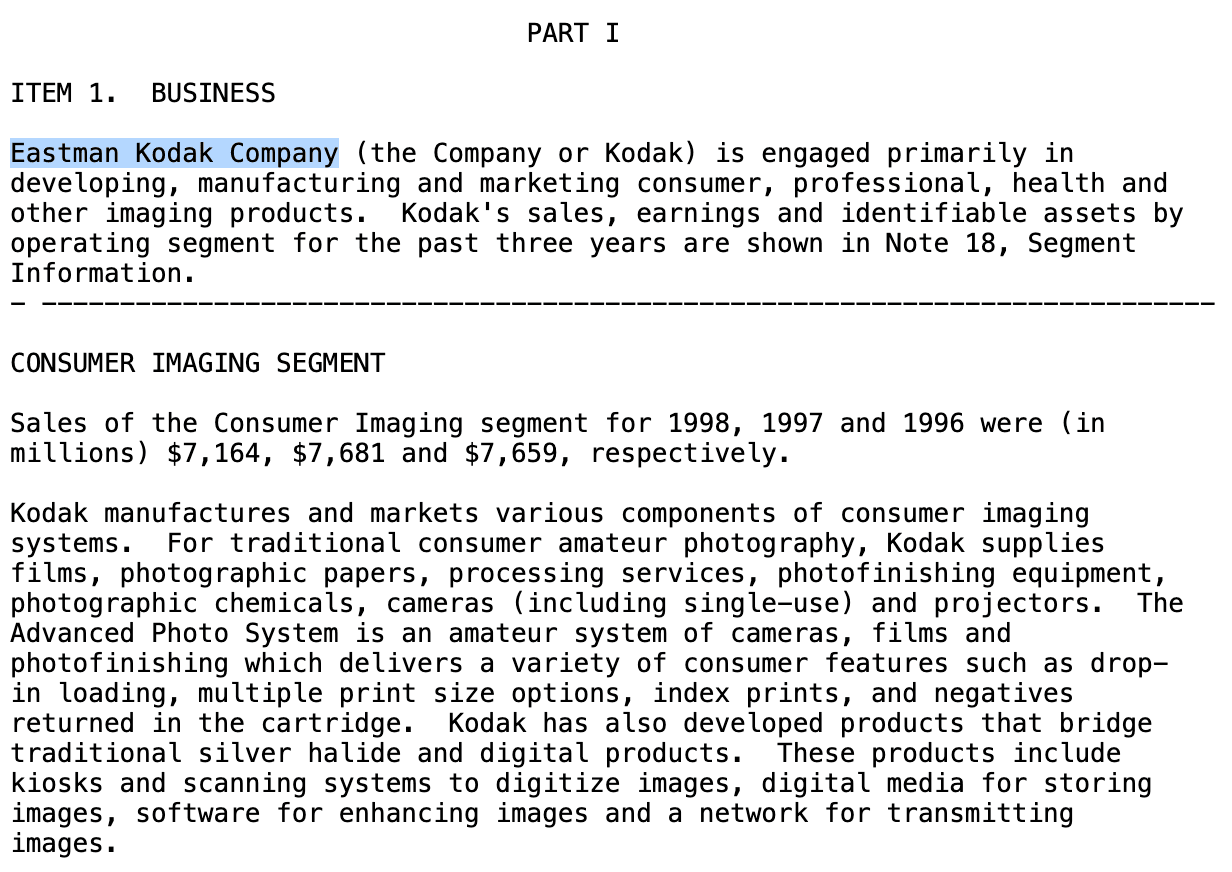 A Kodak annual report (10-K) from the 1990s. Documents like this can be viewed on sec.gov, the website of the US Securities and Exchange Commission
By contrast, today's Eastman Kodak reported company-wide revenue of $1.07 billion in 2025 (Kodak 2025 10-K). The "Film and chemicals" segment, which includes film, has recovered from $215 million in 2023 to $287 million in 2025, and is growing fast, up 43% year over year in Q2 2026. However, this segment also includes industrial and motion picture film as well as photographic chemicals, and price increases contributed too, so that +43% can't be read as "demand for 35mm film rose 43%."
Still film (professional and consumer) is mainly booked as wholesale sales to Kodak Alaris. Based on the disclosure in Kodak's Q3 2025 results announcement that "approximately 33% of the Advanced Materials & Chemicals segment's $316 million in revenue was from Alaris (still film and related chemicals)," we can estimate this at about $104 million. Note that Kodak does not disclose this figure directly, and since Kodak began selling some still films directly in the second half of 2025, sales to Alaris do not represent all of its still film revenue.
| Comparison | Peak | Today | Ratio |
|---|---|---|---|
| Entire photography business → Film and chemicals (nominal) | About $10.2 billion (2000) | $287 million (2025) | About 1/36 |
| Consumer film → Still film–related sales to Alaris (nominal, both estimates) | About $3.5 billion (2001) | About $104 million (2025) | About 1/34 |
| Same, inflation-adjusted (in 2025 dollars) | About $6.3 billion | About $104 million (2025) | About 1/60 |
Putting it all together gives the table above. Judging by these revenue proxies, demand is about 1/34 to 1/36 in nominal terms and about 1/60 after inflation. In terms of the poll options, that falls between 1/10 and 1/100, and on a logarithmic scale it's closer to 1/100.
Counting rolls: layering three sets of statistics
Revenue figures are skewed by changes in unit prices, though, so let's also look at "how many rolls were used." Digging through old records, we found one interesting set of statistics for each region.
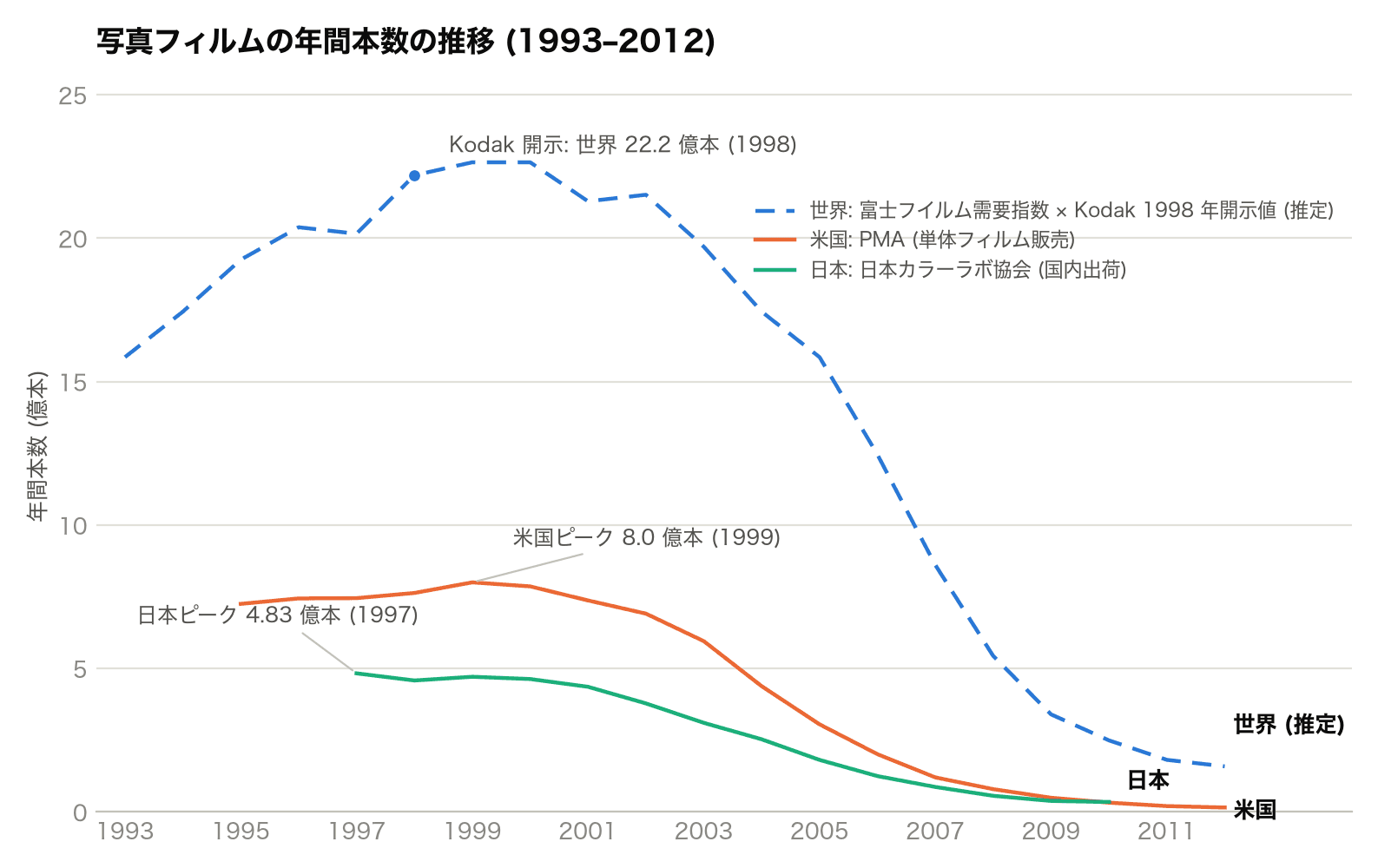 Figure 1: Estimated annual consumption of photographic film in rolls (1993–2012). The world figures are not measured values but estimates, converting Fujifilm's published demand index (2000 = 100, approximate values read from a chart) using the 2.22 billion rolls total for 16 major countries reportedly taken from Kodak's 1998 annual report. US figures are PMA (Photo Marketing Association) unit sales of standalone film (excluding single-use cameras; 2011–12 are forecasts). Japan figures are domestic shipments compiled by the Japan Color Lab Association (including single-use cameras).
First, for the world as a whole, there is a table of consumption by country said to come from Kodak's 1998 annual report (Table 7 of the Finnerty paper). The total for 16 major countries is 2,219.3 million rolls. It is not explicitly labeled an "official total for the global market," but since it covers nearly all the major countries, it should serve well as a baseline for the global scale. Combining this with Fujifilm's published index chart of "total global demand for color film" (2000 = 100), we can estimate that demand was about 2.2 to 2.3 billion rolls around the 2000 peak, then halved by 2006, fell below 1/10 by 2010, and shrank to around 150 million rolls by 2012. Note that the index covers "color film," while the 2.2 billion baseline likely includes black-and-white and other films, so this multiplication is only a rough estimate.
In the US, PMA (Photo Marketing Association) statistics cover 1995–2012. The peak was 800 million rolls in 1999. This fell to 300 million in 2005, 80 million in 2008, and 15 million (forecast) in 2012, a drop to 1/53 in 13 years. Single-use cameras, listed separately, were counted in units rather than rolls, and peaked at 218 million units in 2004.
Finally, in Japan, domestic shipment statistics compiled by the Japan Color Lab Association (日本カラーラボ協会) survive for 1997–2010. The peak was 482.83 million rolls in 1997. By 2010 this had fallen to 34.34 million, or 1/14 in 13 years. (For 2010, the final year, the total in the original table doesn't match the sum of the breakdown, 26.51 million. This article uses the official total; using the sum of the breakdown gives about 1/18.) This suggests that the decline in film consumption may have been less severe in Japan than in the US.
Breaking down the Japanese market
What makes the Japanese statistics valuable is that they include a breakdown by format.
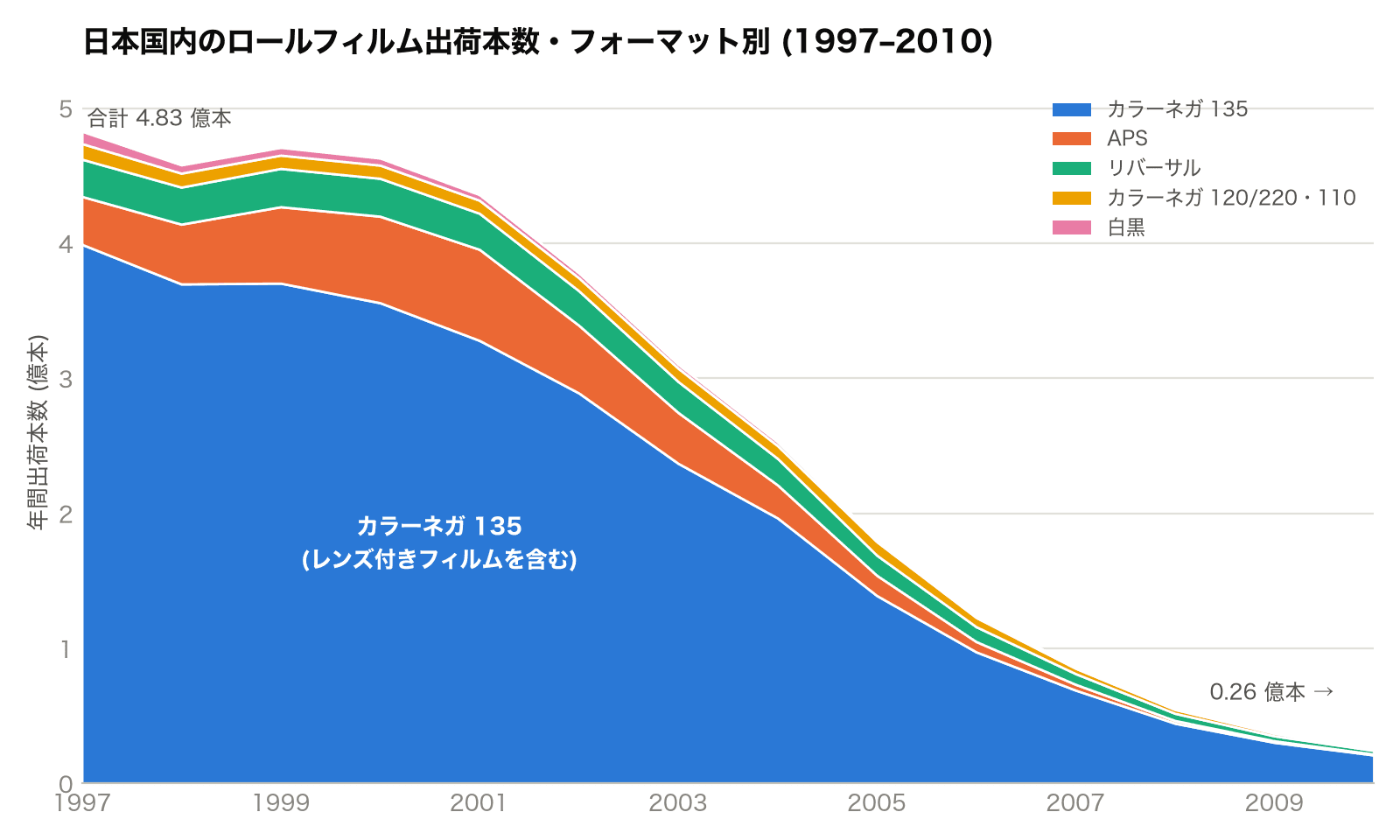 Figure 2: Domestic roll film shipments in Japan by format (1997–2010). Source: Japan Color Lab Association, "Trends in the Domestic Film Market." Color negative 135 includes single-use cameras (Utsurundesu, etc.) as a subset. For 2010, the final survey year, the published total (34.34 million rolls) doesn't match the sum of the breakdown (26.51 million rolls), so the chart uses the breakdown
A few points stand out.
- Color negative 135 consistently accounts for around 80%. Of that, single-use cameras numbered 68.65 million in 1997. That's about one-fifth of standalone color negative 135 (about 330 million rolls), but on its own it was more than twice the size of the slide film market at the time (27.56 million rolls)
- APS (IX240) grew to over 60 million rolls in 1999–2001 before collapsing. The format lasted only about 10 years
- Slide and black-and-white film have enduring popularity. While the overall market shrank to 1/14, slide film went from 27.56 million to 2.69 million rolls (1/10) and black-and-white from 9.15 million to 760,000 rolls (1/12), declines slightly gentler than the average. Perhaps the staying power of professional and enthusiast demand is showing up in the numbers.
And then the statistics disappeared
There is no official answer to the direct question of "how many rolls are sold today." That's because the statistics that counted film sales and roll volumes all ended, one after another, around 2010.
- The Ministry of Economy, Trade and Industry's Current Production Statistics began treating "photographic film" production volume as "confidential" from 2013. The last published figure, for 2012, was 137,642 thousand square meters. Confidential treatment is a confidentiality measure applied when individual results could otherwise be inferred, such as when there are two or fewer reporting establishments
- CIPA (Camera & Imaging Products Association)'s film camera shipment statistics ended in January 2008
- The Japan Color Lab Association's shipment statistics also stop with 2010
Industrial statistics withdraw first from markets that have "become too small to be worth measuring." Film later went through a revival, but the yardsticks for measuring it had already disappeared.
What tells us about the subsequent recovery is not statistics but statements from manufacturers.
- Kodak: Still film production volume more than doubled from 2015 to 2019 (remarks by the film business GM, Kosmo Foto). It was also reported that the company added more than 300 staff over 18 months in 2021–22 (Marketplace) to keep up with rising 35mm demand.
- Harman (ILFORD): Management has repeatedly said the film market is growing, describing it as "5% a year globally" as of 2017 (TIME) and, in a 2024 interview with the MD, "steady at 4–5% a year over the past eight years" (Business Focus Magazine). There is also an article reporting that a multi-million-pound investment doubled its capacity to finish and package (load into cassettes) 35mm film (The Manufacturer) (this does not mean overall production capacity, including emulsion coating, doubled).
- Fujifilm: The company says sales of Utsurundesu (写ルンです) in fiscal 2025 were about 1.5 times the previous year (ITmedia), and its earnings announcements point to strong performance from INSTAX (Cheki).
Working backward from the revenue ratio (about 1/35 nominal, about 1/60 inflation-adjusted) and current price levels, it seems reasonable to put today's global volume on the order of 1/50 to 1/100 of the peak, or in the tens of millions of rolls per year.
Checking the poll answers
Checking the answers again, the most popular answer, "1/1000," is probably an underestimate. Since no definitive figure exists, we can't declare a "correct" answer, but the option most consistent with this analysis is the runner-up, "1/100."
That said, we understand the instinct to answer "1/1000." Minilabs closing one after another around town and film sections at big electronics stores shrinking really do feel like far more than a 1/100 decline. Even so, by the numbers, film appears to be not a market "recovering from the brink of extinction," but "a market that shrank to around 1/50 to 1/100 and has been growing at 4–5% a year since." The reason the revenue proxy is only down to around 1/35 even though roll volume fell to the order of 1/100 is that the price per roll is now several times what it was. The shift from a mass-produced commodity to a higher-priced hobbyist product shows up directly in the gap between the two ratios.
Data sources
Here is a summary of the sources for the roll-count data used in the article and figures.
| Series | Period | Content | Source |
|---|---|---|---|
| World | 1998 | 2,219.3 million rolls (total consumption for 16 major countries) | Table 7 of the Finnerty paper (a 16-country consumption table said to come from Kodak's 1998 annual report; it appears in the annual report to shareholders, not the 10-K filed with the SEC. An article tracing the citation trail) |
| World | 1993–2012 | Demand index (2000 = 100) | Fujifilm submission (METI Subcommittee on Value Creation Management, 2025) and others |
| World | 2015–2026 | Growth rates and multiples (manufacturer statements) | Kosmo Foto, TIME, Business Focus Magazine, Marketplace, ITmedia |
| US | 1995–2012 | Unit sales of standalone film | PMA Marketing Research tables |
| US | 1983–2000 | Film unit sales (including instant) | Harvard Business School case "Kodak (A)" (2003, original source PMA) |
| Japan | 1997–2010 | Domestic shipments (by format) | Japan Color Lab Association, "Trends in the Domestic Film Market" (data from the old site supplemented via the Internet Archive) |
| Revenue | 1996–2007 | Kodak segment revenue | Kodak 10-K filings by year (SEC EDGAR) |
| Revenue | 2023–2026 | Kodak product line revenue | Kodak 10-K / 10-Q (SEC EDGAR) |
This research began with reading through financial filings from the 1990s, and it ended with a more upbeat estimate than we expected: the decline of film probably bottomed out on the order of 1/100, not 1/1000, and the market has now turned to growth. FilmFocus will continue to investigate trends in film photography using real data.