NewsBy FilmFocus
Exploring the Psychological and Social Meaning of Film Photography: A Study of 600 People in Southeastern China, Published in Scientific Reports
This is an AI translation of an article originally published in Japanese. If anything reads oddly, the Japanese original is the authoritative version.
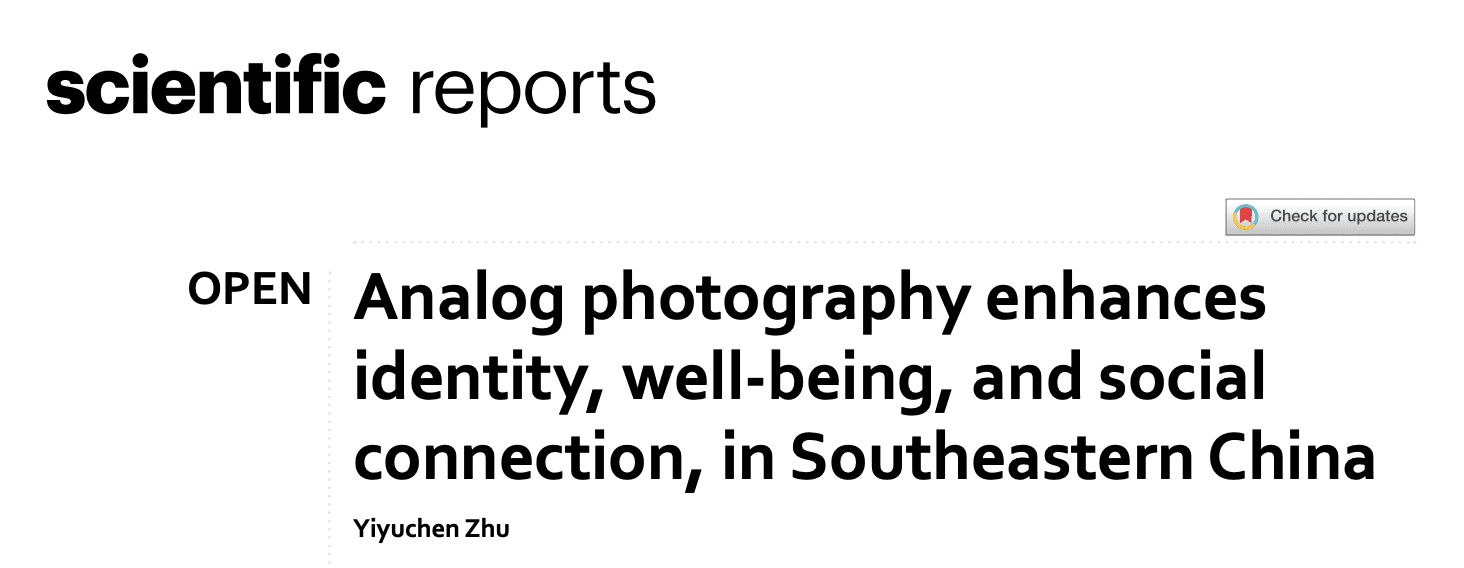 Source: nature.com
In an age dominated by digital, why do people deliberately choose film photography? A study exploring its psychological and social meaning has been published in Scientific Reports, an open-access journal from Nature Portfolio. The researchers surveyed 600 people aged 18 to 50, recruited in Southeastern China, mainly in Fujian and Zhejiang provinces, and analyzed how engagement with film photography relates to self-esteem, perceived stress, sense of community belonging and other measures.
Nostalgia and mindfulness as the links
The study used a mixed-methods design, running a questionnaire survey and interviews in parallel. The quantitative survey covered all 600 participants, while the qualitative part covered 30 of them, selected through purposive sampling.
The 75-item questionnaire included established measures such as the Southampton Nostalgia Scale, along with an original "Analog Photography Engagement Scale" measuring shooting frequency, spending and time invested, and a scale measuring sense of community belonging.
Put simply, the results showed an association: the more often people shoot film, the higher their self-esteem and the lower their stress. The paper suggests that film photography's sense of "continuity with the past" and "the shooting experience itself, which directs attention to the present moment" may be what has the psychological effect.
However, this is self-reported data collected at a single point in time. It can't tell us whether shooting film increased nostalgia and mindfulness, or whether people who were already inclined that way become more deeply involved with film. It's more reasonable to read nostalgia and mindfulness as "proposed candidates linking" the two. Given the nature of the study, establishing statistical causality is difficult, and bias from how respondents were recruited can't be fully ruled out, but it's interesting that such an association was identified.
Four latent classes in the sample
A latent class analysis identified four groups with different motivations and patterns of engagement. The names were assigned by the author based on an interpretation of each group's characteristics.
| Latent class | Share of sample | Main characteristics |
|---|---|---|
| Nostalgic Purists | 20% | Relatively older; value tradition, culture and darkroom work |
| Aesthetic Explorers | 35% | Relatively younger with high engagement; experiment in pursuit of a distinctive visual expression |
| Social Connectors | 25% | High sense of community belonging; value sharing and interaction |
| Mindful Contemplatives | 20% | High mindfulness and the lowest stress; value the process and reflection |
In the interviews, participants talked about the anticipation of watching an image appear in the developer, becoming absorbed in shooting and darkroom work, and tactile sensations such as the weight of a metal camera and turning its dials. One participant described a print as "not just a photo, but a part of my life."
On social interaction, the paper quotes remarks to the effect that online communication is convenient for quick questions, but deep bonds form when people meet in person and spend hours talking while showing each other prints. The paper positions photo clubs, shared darkrooms and print-swap gatherings as "third places" that are neither home nor work.
What it means for readers in Japan
Results obtained in the cultural and social context of Southeastern China can't simply be generalized to Japan. On the other hand, the framework that treats "time spent waiting," "prints that remain as physical objects" and "the feeling of working with your hands" as sources of value overlaps in part with how film photography is talked about in the Japanese market. For example, when Fujifilm announced the "Utsurundesu+" (写ルンです+) in 2025, it explained that the limited number of shots and the wait for development amplify the experience and feelings at the moment of shooting.
The value of this paper lies not in proving that "film photography makes people happy," but in taking an appeal that has so far been described in intuitive terms, breaking it down into measurable concepts such as nostalgia, mindfulness, self-evaluation, stress and belonging, and presenting it as testable hypotheses. The paper is published open access, so if you're interested, give it a read.