ColumnsBy FilmFocus
"You Can Even Develop Film with Urine": Reading the Classic The Film Developing Cookbook
This is an AI translation of an article originally published in Japanese. If anything reads oddly, the Japanese original is the authoritative version.
One of the great appeals of film photography is that different combinations of film and developer, and different development processes, produce different results. This time we're introducing a book published in 1998 that explains the characteristics of developers and processes for black-and-white photography. While C-41 has become the industry standard for color negative film, black-and-white film has never been standardized to the same degree. As a result, film enthusiasts have kept searching for the best developer and development time for each film, and this book is a valuable record that serves as something of a snapshot of that search as it stood in 1998.
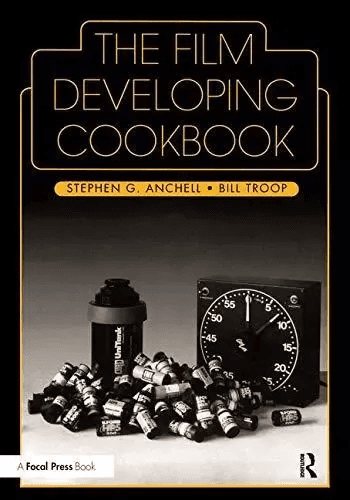
Background of "The Film Developing Cookbook"
The book covers how to use various types of developer to achieve different effects, how to mix and prepare developers from raw ingredients, and development methods that improve the long-term permanence of film. A notable feature is that it includes developers and films whose names you still hear today, such as D-76 and ID-11.
The book came about because of questions about T-Max film. After one of the authors, Steve Anchell, published another book, "The Darkroom Cookbook," he reportedly received many requests along the lines of "I want to know the best way to develop T-Max film." He brought the idea to his co-author Bill Troop, and a project began to organize the film development "recipes" Troop had been collecting since the 1980s. Scientists from Eastman Kodak, including Dr. Grant Haist, contributed to the book, and the acknowledgments even mention Ansel Adams, famous for his California landscape photography.
On the Eve of the Digital Wave
The book came out in 1998, just as film photography was beginning to lose ground to digital. In the foreword, the authors wrote "Long may Silver Photography Live," which shows how strongly they wanted to pass the silver-based photographic techniques of the time on to the next generation.
Despite being written in that era, many of the development techniques it describes still hold up today. For example, "keep powdered developer in powder form until just before you develop" and "use distilled water as much as possible during the development process" are tips that are well known in film development labs today.
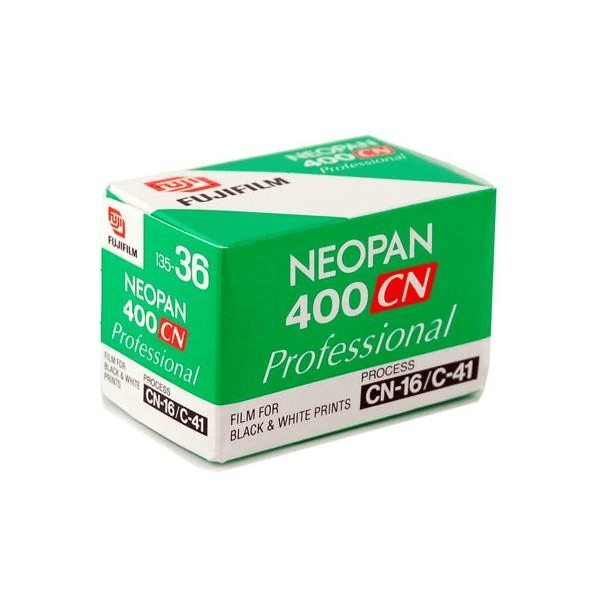
The book also devotes a chapter to film. It covers films that are still available today, such as Kodak Tri-X and Ilford FP4 Plus / HP5 Plus. Of Fujifilm's Neopan series, it says "The Neopan films have not been available long enough in the US to carve a niche," suggesting that they were not yet well known in the West.
 Source: analoguewonderland
Black-and-White Development with Urine!?
Chapter 3 takes a detailed look at the raw ingredients of developers. There are records of past attempts to develop film using all sorts of substances, and the book mentions black-and-white photos developed using "polluted lake and pond water," "old red wine," and "human urine." Seven substances were considered practical to use, and among them was ascorbic acid, better known as vitamin C.
For the development process, the book lists the common technique of "agitating for 10 seconds every minute," but it also introduces a method called "Minimal Agitation," in which agitation is kept to a minimum. This is said to be a method Ansel Adams used in the 1980s to increase image sharpness; it involves agitating every 3 minutes and extending the development time by about 50%. According to Geoffrey Crawley, who first introduced the technique, it is best combined with "non-solvent" developers that are used diluted, such as FX1 and FX2.
The Most Important Developer of the 20th Century: "D-76"
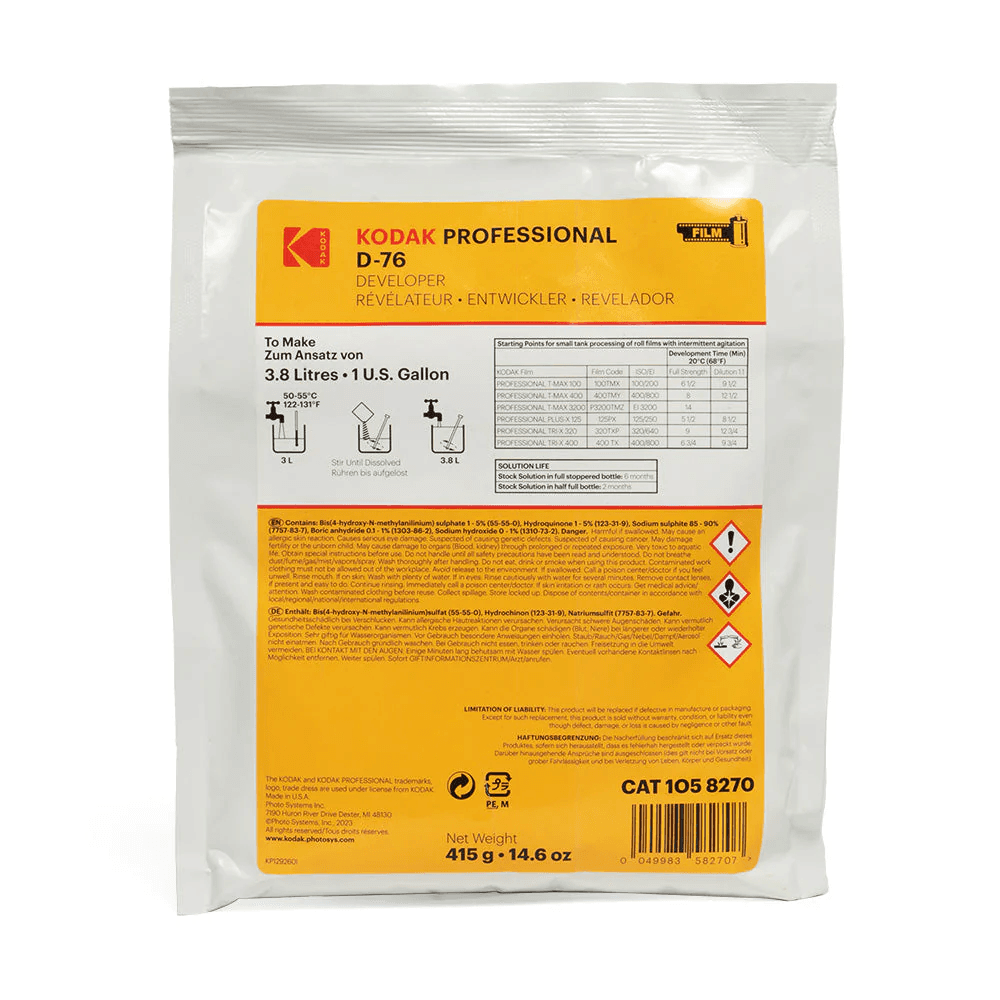
Of the many developers covered, the book singles out D-76 for high praise as "the most important developer of the 20th century." Although it was developed in the 1920s, it was still considered highly reliable in the '90s when the book was written. The reason given is that because D-76 became established as the standard, film manufacturers tuned their films with D-76 in mind. The authors wrote that "as long as black-and-white film photography survives, D-76 will continue to be produced," but Kodak D-76 for the Japanese market was discontinued in 2022. Since it is still sold in the US, it seems fair to say that the prediction has been partly fulfilled as of January 2025.
 Source: cinestillfilm.com
Push Processing
The later chapters also cover push processing (pushing) in film photography in detail. This is a method in which you shoot at a higher sensitivity setting than the ISO printed on the film (in other words, underexposing) and compensate by extending the development time (overdeveloping). The benefits include faster shutter speeds thanks to the higher sensitivity setting, and the contrast and grain that are unique to pushed film. According to the book, FX1 is best for pushing older-generation films, while XTOL is best for T-Max P3200 and Delta 3200. More and more people are shooting expired film these days, and expired film often gives better results when push processed. The developers and techniques introduced in this book may well be a useful reference.
Appendix and Closing Thoughts
At the end of the book is a 17-page appendix of recommended development times by film and by developer. It is a valuable resource for learning about the black-and-white films and developers sold in the 1990s. Copies circulate reasonably often on the used book market, and the appendix in my own copy contains handwritten notes that appear to be traces of someone actually developing film with the book as a guide. If you're interested in what black-and-white film development was really like in the 1990s, why not pick up a copy?